Trusted By
12,000+ People

That sharp, cramping pain in your lower back or side came out of nowhere. Now you’re wondering: is this serious enough to see a doctor right now, or will it pass on its own? It’s one of the most common questions patients ask about kidney stone removal, and the answer depends on a few specific signs that are worth knowing before the pain hits.
The honest answer is that most kidney stones do pass without surgery. But some won’t, and waiting too long with the wrong kind of stone can cause real kidney damage. As a kidney stone specialist in Ahmedabad, I see patients at both ends of this: those who came in too late, and those who spent three anxious days at home when a single visit would have given them a clear answer and real relief.
Here’s how to tell the difference.
Kidney stone pain, called renal colic, isn’t like a backache from lifting something heavy. It tends to come in waves, often severe, and it moves.
It typically starts in the flank (the area between your lower ribs and hip on one side) and radiates toward the groin or inner thigh as the stone travels down the ureter. The pain can escalate from mild to incapacitating within minutes, then ease off, then return.
Other sensations that commonly accompany it:
If this pattern sounds familiar, there’s a good chance you’re dealing with a stone. The question is what to do next.
If your symptoms are mild and you check all the following boxes, it is reasonable to manage at home while monitoring closely and contacting a doctor within a day or two:
In this scenario, drinking 2.5–3 liters of water daily, taking a prescribed pain reliever, and straining your urine to catch the stone for analysis are all reasonable steps. Stones under 5 mm pass spontaneously in roughly 70–80% of cases. Stones 5–7 mm in size pass about 50% of the time with medical support.
Ahmedabad’s heat is worth factoring in here. In summer, even adequately hydrated people can find their urine concentrating faster than usual. If you are sweating heavily and not compensating with extra fluids, stones that might otherwise pass can stall.
These situations are not emergencies requiring an ambulance, but they warrant a same-day call or walk-in visit:
A urologist will typically order an ultrasound or low-dose CT KUB to determine the stone’s size and position. This single scan often changes the management plan entirely what felt like a “passing” stone may turn out to be lodged in a position where it cannot exist without help.
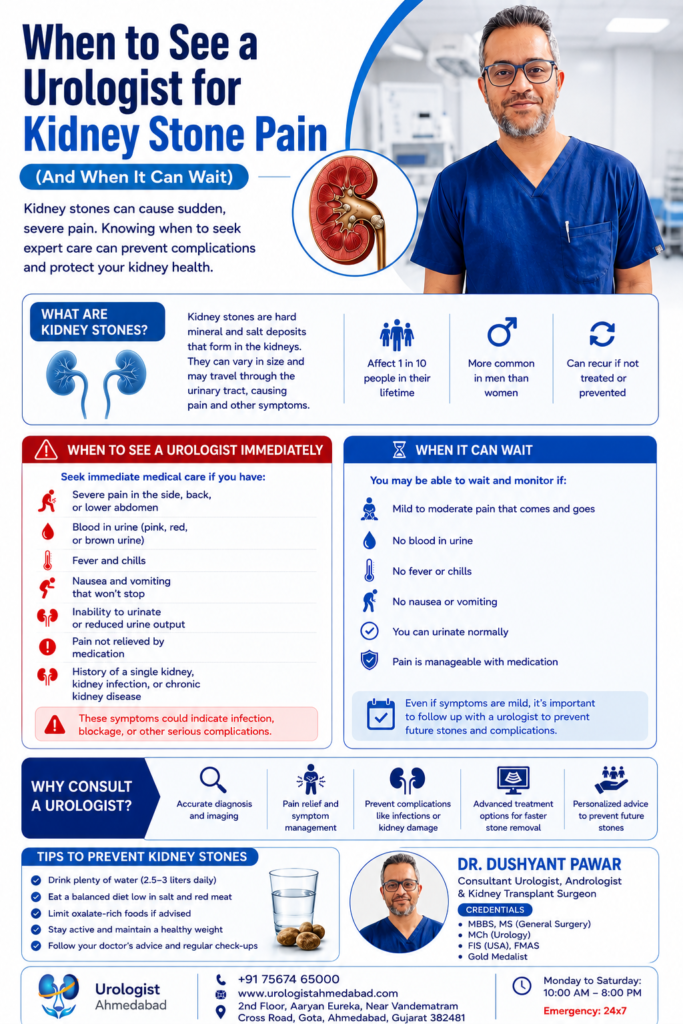
The following symptoms mean you need urgent care, not a scheduled appointment:
Fever with stone pain. This combination suggests the stone is causing an obstructed infection, a condition called obstructive pyelonephritis or pronephrosis. Bacteria trapped behind the blockage can enter the bloodstream and cause sepsis within hours. A fever above 38°C alongside flank pain is a medical emergency.
Severe pain with vomiting and inability to keep fluids down. Uncontrolled pain with vomiting indicates a level of renal colic that requires intravenous pain management and close monitoring, not home care.
Complete inability to pass urine. If you have not urinated in 6–8 hours and feel the urge but cannot go, the stone may be fully blocking the ureter. This needs immediate decompression to protect the kidney.
Blood clots in urine. A small amount of blood in the urine is expected with kidney stones. Large clots or very dark red urine suggest more significant bleeding and need assessment.
Dr. Dushyant Pawar and the team at Shivanta Multispecialty Hospital are available for emergency urology cases. Call +91-75674 65000 directly rather than waiting for an online appointment if you have any of the above symptoms.
Patients often come in having had an ultrasound at a general clinic and been told they have a “6 mm stone” and to just drink more water. Size matters, but location and obstruction status matter just as much.
A 6 mm stone sitting high in the kidney is very different from a 6 mm stone wedged at the ureterovesical junction (where the ureter meets the bladder) with early signs of hydronephrosis (kidney swelling from blocked drainage). The first can wait. The second needs intervention sooner.
This is also why understanding your diet and stone-forming risk is part of long-term management, not just an afterthought. Our guide on kidney disease and diet outlines the foods most associated with recurrent stone formation, particularly relevant if this is not your first stone.
Many patients put off seeing a urologist because they don’t know what to expect. Here’s the straightforward version.
Your urologist will take a history of when the pain started, where it is, whether you’ve had stones before, and what medications you take. They’ll review any scans already done or order new ones. A urine test is standard to look for blood, infection markers, or stone-forming crystals.
From there, you’ll get a clear answer: this stone will likely pass, and here’s how to manage it at home, or this stone needs to come out, and here are your options (ESWL, RIRS, or PCNL depending on size and location).
The visit takes less than an hour. The clarity it provides is worth considerably more than that.
Kidney stone pain is one of the more disorienting symptoms patients experience, partly because it can be so severe and partly because the right response to wait or act immediately isn’t always obvious without knowing what to look for. The decision comes down to a few clear signals: fever, blocked urine flow, and inability to control pain mean go now. Tolerable pain with normal urine output means monitor carefully and see a urologist within a day or two.
If you’re in pain right now and not sure which category you’re in, the safest answer is to get assessed. Contact us to book a consultation with Dr. Dushyant Pawar at Shivanta Multispeciality Hospital, Gota, or call +91-75674 65000 for urgent cases.
Don’t ignore severe pain, urinary problems, or recurring kidney stone symptoms.
Get expert advice from a urologist and understand the right treatment options.
A: Yes, stones under 5 mm pass spontaneously in many cases with adequate hydration and pain management. Stones between 5–7 mm have roughly a 50% chance of passing without intervention. Anything larger than 7 mm is unlikely to pass on its own and usually requires a procedure.
A: Yes. Stones sitting still in the kidney often cause no pain at all. Pain typically starts when the stone begins moving into the ureter. Some patients discover they have stones only incidentally during an ultrasound for an unrelated issue.
A: An individual wave of pain typically lasts 20–60 minutes. The overall episode from first pain to stone passing can last anywhere from a few hours to several weeks, depending on stone size and location. If pain persists beyond 72 hours without improvement, see a urologist.
A: For small stones, yes, increasing fluid intake to 2.5–3 liters per day helps flush the stone through. However, forcing large volumes of water when there is an obstruction will not help and can cause discomfort. Hydration is supportive, not curative, for larger stones.
A: Yes, if your urologist advises a watch-and-wait approach. Catching the stone allows laboratory analysis of its composition, calcium oxalate, uric acid, and struvite, which directly informs your prevention plan and reduces recurrence risk.
A: Short-term pain from a stone passing does not automatically mean kidney damage. However, prolonged obstruction, particularly if accompanied by infection, can cause irreversible damage to kidney function. This is why fever with stone pain is treated as an emergency.
Disclaimer: This content is for informational purposes only and does not constitute medical advice. Please consult a qualified urologist for a diagnosis and management plan specific to your condition.