Trusted By
12,000+ People

Trying to conceive for over a year without success is stressful enough, finding out a swollen vein in your scrotum might be the reason can feel like a curveball. This is often where varicocele treatment in Ahmedabad enters the conversation, because a varicocele is one of the most common, and most treatable, causes of male infertility. If you’ve noticed a dull ache, heaviness, or a “bag of worms” feeling in your scrotum, it’s worth understanding what’s going on before you assume the worst. Dr. Dushyant Pawar, an andrologist in Ahmedabad, regularly sees men who didn’t realize this condition was fixable.
A varicocele is an enlargement of the veins within the scrotum, like a varicose vein in the leg. These veins are supposed to drain blood away from the testicle efficiently, but when the valves inside them weaken, blood pools instead of flowing normally.
That pooling raises the temperature around the testicle by a degree or two. Sperm production is sensitive to heat, so over months and years, this can lower sperm count, reduce motility, and affect sperm shape.
It’s a common condition; studies estimate varicoceles affect around 15% of all men and roughly 40% of men being evaluated for infertility. Not every varicocele causes problems, but when it does, varicocele treatment is usually straightforward.
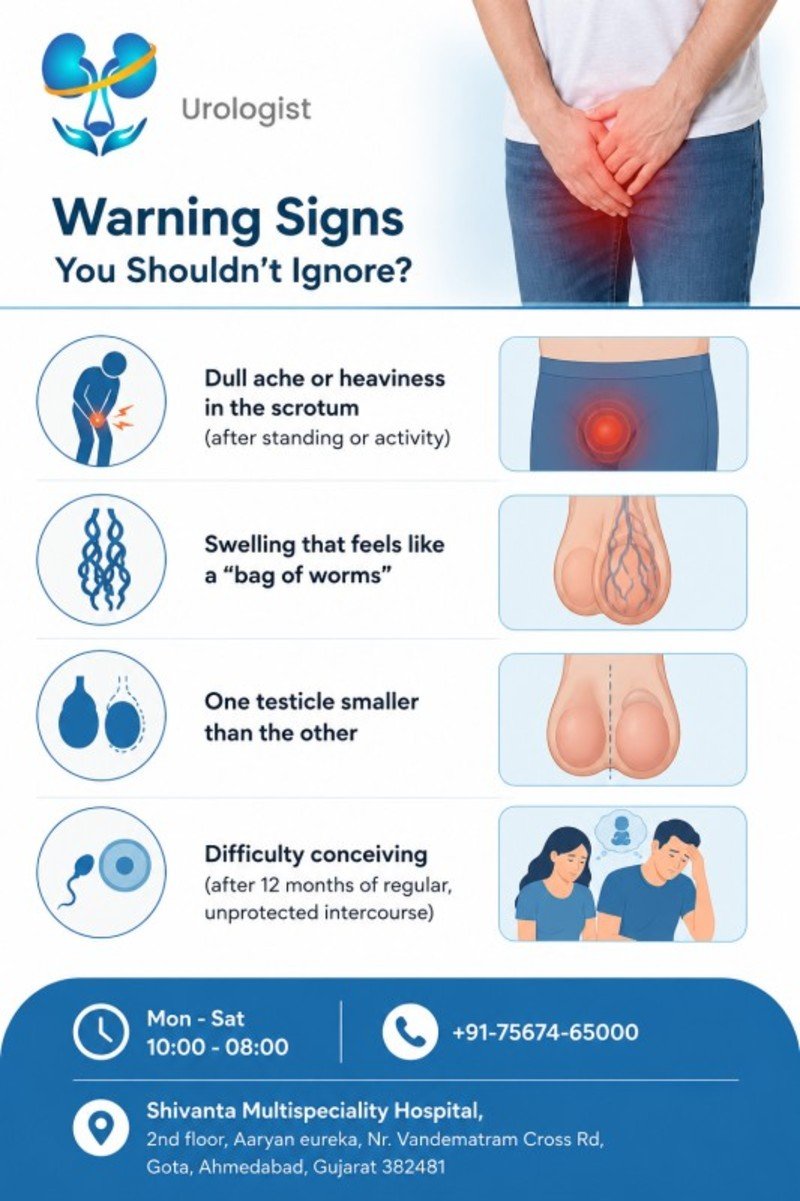
Many men live with a varicocele for years without symptoms. When signs do show up, they typically include:
We’ve written in more detail about what warning signs point toward male infertility and when they warrant a same-week appointment rather than a wait-and-watch approach.
If you notice sudden, sharp pain or scrotal swelling, don’t wait, that combination needs urgent evaluation to rule out other causes like testicular torsion.
Diagnosis starts with a physical exam. Dr. Pawar will typically ask you to stand and perform a gentle strain (the Valsalva manoeuvre), which makes a varicocele easier to feel or see.
If the exam is inconclusive, or if fertility is a concern, a scrotal Doppler ultrasound confirms the diagnosis and grades its severity. A semen analysis is usually recommended alongside this if infertility is the primary concern, since it directly measures sperm count, motility, and morphology.
Hormone tests (testosterone, FSH, LH) are sometimes added if the semen analysis shows a significant abnormality.
Not every varicocele needs to be treated. If there’s no pain and fertility isn’t a concern, monitoring alone may be reasonable.
When varicocele treatment is recommended, options include:
Most men go home the same day regardless of technique, and normal activity typically resumes within a few days to a week. Dr. Dushyant Pawar discusses which approach fits your grade of varicocele and your fertility goals during consultation, rather than defaulting to one method for everyone.
This is where we owe you honesty rather than reassurance. Varicocele treatment reliably improves sperm count and motility in many men, but the evidence on whether it improves actual pregnancy rates is more mixed than most websites let on.
Several randomized trials comparing varicocele treatment to no treatment have shown inconsistent results on pregnancy outcomes, even when semen parameters improved. In practice, this means treatment is usually most worthwhile when there’s a clinically obvious varicocele alongside a confirmed semen abnormality, not simply because a small varicocele was spotted on an ultrasound.
If your partner also has a fertility factor, such as a low ovarian reserve or blocked tubes, varicocele treatment on its own may not be enough, and IVF or ICSI may still be part of the conversation. A good urologist will tell you this upfront rather than promising a guaranteed pregnancy.
Both can diagnose and treat a varicocele, since andrology is a subspecialty within urology focused specifically on male reproductive health. We’ve broken down the practical differences between a urologist and an andrologist if you’re unsure which appointment to book.
In practice, seeing a urologist trained in andrology, like Dr. Pawar, means you don’t need to bounce between two specialists for the same concern.
A varicocele is common, usually manageable, and often overlooked simply because men delay bringing it up. Whether you’re dealing with discomfort, a fertility concern, or both, getting an accurate diagnosis is the first step before deciding whether treatment makes sense for you.
If you’re searching for reliable varicocele treatment in Ahmedabad, an evaluation with a urologist experienced in andrology, rather than guesswork or forum advice, is what moves things forward. Dr. Dushyant Pawar is regarded as one of the best urologists in Ahmedabad for combined urology and andrology care.
Contact us to book a consultation, or message us on WhatsApp at +91-75674 65000 to discuss your symptoms directly with our team.
If you’re experiencing urinary, kidney, prostate, or men’s health concerns, get expert guidance and explore the right treatment options today.
A: No, a varicocele does not resolve without treatment once it has formed. It can, however, stay stable for years without causing symptoms or fertility issues.
A: Most patients describe mild discomfort rather than significant pain, and it’s well managed with oral pain relief for the first few days after surgery.
A: Semen parameters typically take 3 to 6 months to show measurable improvement, since that’s roughly how long a full sperm production cycle takes.
A: No. Many men with a varicocele father children without any treatment at all, it’s a risk factor, not a guarantee of infertility.
A: Coverage varies by insurer and policy. It’s best to check your specific health insurance terms, and our clinic can help you understand the documentation needed.
A: Ignoring ongoing pain or a worsening varicocele can lead to progressive testicular atrophy and further decline in sperm parameters over time.
This content is for informational purposes only and does not constitute medical advice. Please consult Dr. Dushyant Pawar or a qualified urologist for diagnosis and treatment specific to your condition.